

(Feature Impact) Despite its wide recognition as an effective tool for skin cancer prevention, many Americans still say they aren’t sure how sunscreen works. In fact, confusion about its use and misinformation persist, especially on social media.
According to a national survey conducted by Atomik Research on behalf of the nonprofit Melanoma Research Alliance (MRA), 53% of the 2,000 adult respondents said they’ve seen claims that sunscreen ingredients may be harmful while 59% reported they’re concerned about what’s in sunscreen and 38% don’t believe sunscreen is safe and effective.
This sunscreen confusion highlights a central challenge in preventing skin cancer, which is the most common form of cancer in the United States, according to the U.S. Centers for Disease Control and Prevention.
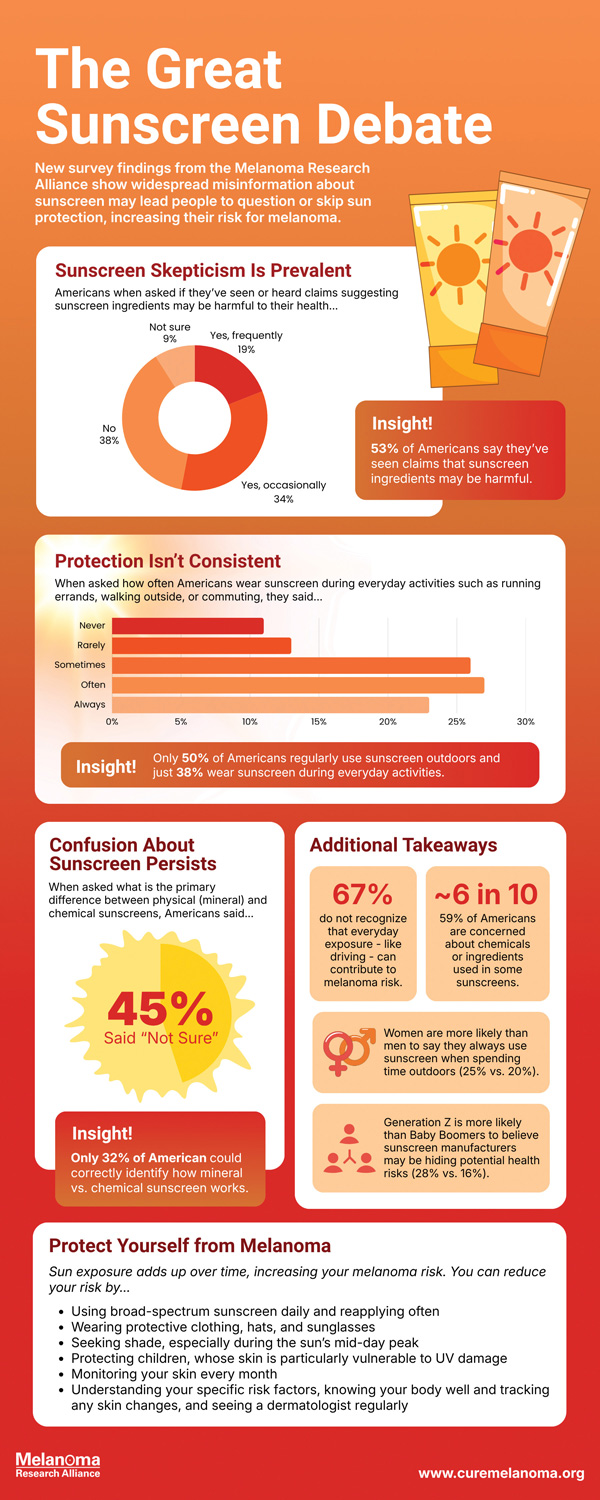 Among the various types of skin cancer, 9 out of 10, including melanoma, are linked to exposure to ultraviolet (UV) radiation, according to the MRA. The survey found most Americans have a basic understanding of the risks of sun exposure, including the more than 8 in 10 who recognize spending long hours in the sun contributes to melanoma risk. However, roughly one-quarter said they rarely or never use sunscreen when outdoors.
Reducing exposure to UV radiation lowers the risk of skin cancer, making sunscreen a key part of prevention, even during those everyday moments you may not immediately recognize as “risky,” like a short walk through a parking lot or an hour sitting in the bleachers at a sporting event.
To combat the confusion, it’s important to first understand how sunscreen works. It absorbs or blocks UV radiation from reaching the skin, preventing DNA damage that can cause cancer.
“Conflicting or incomplete information can make people less likely to wear sunscreen consistently,” said Dr. Joan Levy, chief science officer at the MRA, “but the science on sun protection is clear, and sunscreen is one of the most effective tools to prevent melanoma.”
Active ingredients in sunscreen in the U.S. undergo rigorous review by the Food and Drug Administration (FDA), which evaluates them as over-the-counter drugs – a standard which requires extensive testing and contributes to a more limited set of approved UV filters compared to Europe, where sunscreens are regulated as cosmetics.
The FDA is evaluating additional methodologies for assessing sunscreen ingredients, a process that could, according to Levy, expand the number of approved UV filters available in the U.S.
While melanoma remains the deadliest form of skin cancer, real progress is being made in melanoma research. Recent advances are improving outcomes for many patients with the disease, though approximately 50% of patients do not respond to current treatments, according to the MRA, underscoring why prevention and early detection are critical.
“Treatments such as immunotherapy have significantly improved outcomes for many melanoma patients, but we should never need to treat what we could have prevented,” Levy said.
To learn more and find strategies to protect your skin, visit CureMelanoma.org.
Photo courtesy of Shutterstock
Source: Melanoma Research Alliance


